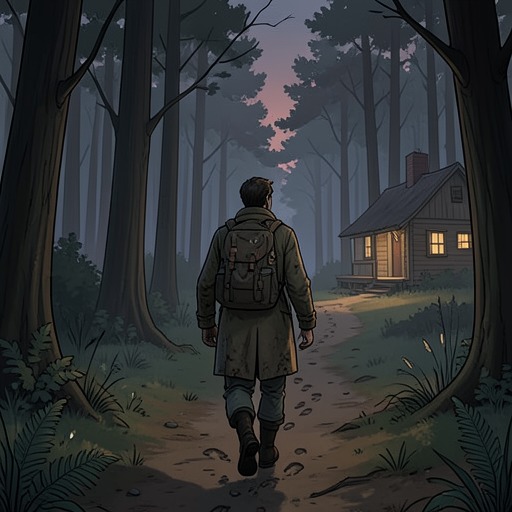
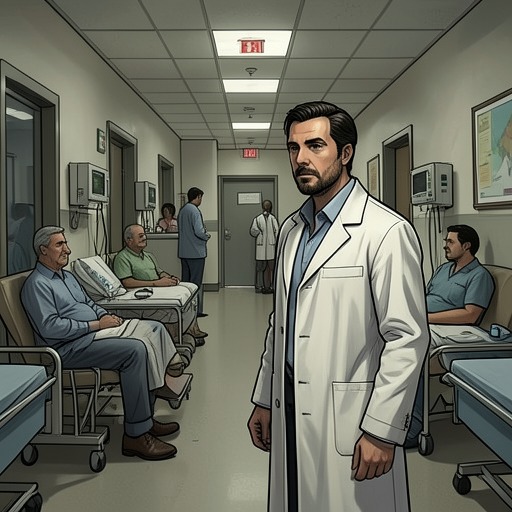
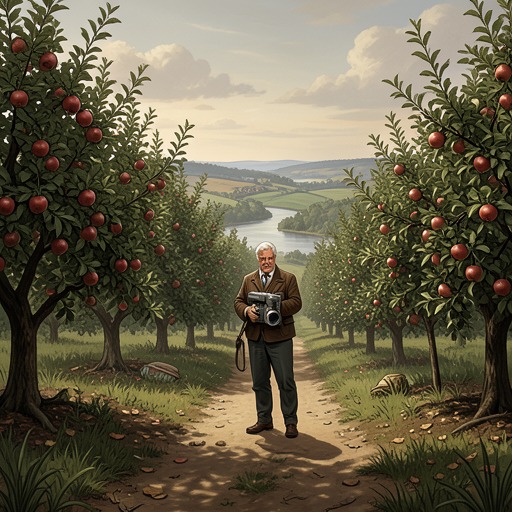
Event 1
Ben Givens's terminal cancer diagnosis
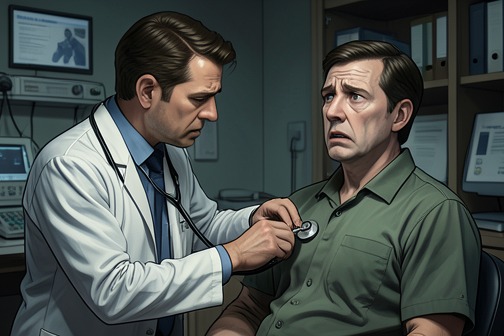
[Ben Givens's terminal cancer diagnosis](entity:event-recall-event-ben-givens-s-terminal-c-c74e756f9e7d) is the decisive reversal that makes his professional understanding of mortality personal: the doctor who once treated failing hearts must now reckon with an illness he cannot cure and an ending he believes he can foresee.
## Diagnosis and the Physician's Reversal
For years, Ben had approached medicine as a practice of intervention. His precise, powerful hands and confidence in his work had helped patients trust him, while a tactical focus kept him from feeling wholly responsible when they died. He understood that bodies were mortal and their hearts fallible, but death had remained something encountered in other people, at a distance. His own diagnosis broke that distance. Told that he had only months to live, he recognized the verdict not as an abstraction but as a prognosis he could neither treat away nor evade.
## The Prognosis and Its Foreseen Course
The diagnosis was not merely a name for an illness: Ben understood its anatomy and its likely progression. The cancer had spread from the mucosa of his colon to nearby lymph nodes and then to his liver. His medical experience made the prospect unusually concrete. He imagined bedsores and broken bones, infection from a catheter, fluid drained from between his organs, vomiting, dehydration, weakness, cracked lips, difficulty swallowing, pneumonia, fever, and finally the sensation of strangling. In his forecast, he would dwindle to eighty-five pounds and gasp his last in a nursing-home bed; only then, he expected, would [Bill Ward](entity:character-recall-character-bill-ward-23b17b8a49b5) give him morphine through a drip to hasten death. The diagnosis thus brought not only a limited span of life but an anticipated sequence of bodily losses over which Ben believed he would have little control.
That forecast sharpened his distinction between being dead and the process of dying. He could sometimes imagine death itself as painless, like sleep, but regarded the passage toward it as a trial that might include pain beyond argument or endurance. He knew the counterargument: gradual dying could make ordinary details newly vivid, deepen love, and allow time for reflection. Yet he doubted that such consolations could withstand the worst pain, which he had seen patients endure and understood might overwhelm every reassuring idea. He did not consider the wish to avoid that suffering cowardly; to him, pain was indifferent to character or virtue, and endurance offered no simple proof of bravery.
From this reasoning came his decision to end his life before the disease could carry him through the course he feared. He saw suicide as a deliberate way to remove the pain and horror of dying, a rational choice among evils rather than a rejection of the fact of death. Still, his composure was unstable: he could briefly regard his end with calm detachment, then return to melancholy, estrangement, and the fear that he would regret leaving the world. The diagnosis made death certain in his mind, but it did not resolve how he should meet it.
## The Diagnosis in Daily Life
The diagnosis followed Ben into ordinary attempts at rest. In a motel room in [Quincy, Washington](entity:location-recall-location-quincy-washington-21fb2e862b1a), he massaged his side as if he could knead the cancer away; the pain in his gut was sharp enough to keep him awake. Seeking relief, he smoked a marijuana cigarette given to him by a drifter, but the altered state brought confusion and paranoia rather than certainty. He worried that the smoke would expose him to the police, opened the windows, and lit incense from a carton given to him by young travelers. Its long journey from Tibetan monks near the Sikkimese border to a motel in sagebrush country briefly seemed to him evidence of God’s reach, even as his own body remained beyond his control.
The illness also made his fear of death harder to keep beneath his habitual stoicism. In a fruit pickers’ hut, Ben felt the chill of death, though exhaustion, nausea, and marijuana left him unsure how much to trust his perception. The carabiner and piton against his chest—equipment designed to hold a climber to a rock face—became a measure of the difference between the young travelers’ romantic challenge to danger and his own knowledge of bodily decline. He searched again for a way to make leaving the world endurable, but found no answer; his days alternated between fear and brief intervals of calm, when work, love, or simple distraction drew his attention elsewhere.
In the motel, he turned from television to the Bible and read the Book of Job. Its account of suffering disturbed him: God and Satan seemed indifferent to their test, and Job’s eventual restoration, wealth, and new family felt too neatly happy until Ben remembered that Job still died. The reading did not settle the meaning of his illness. Instead, it sharpened the distance between a consoling story of recovery and the certainty he understood in his own prognosis.
## The Earlier Lesson of an Incurable Illness
Ben had confronted the limits of medicine before his own diagnosis, when [Dr. Williams](entity:character-recall-character-dr-williams-1287b5da0ec7) told the family that his mother, [Lenora Givens](entity:character-recall-character-lenora-givens-33fc88503072), had pancreatic cancer and could not be cured. Ben answered with the protest of a son who still expected a doctor to be able to intervene; Dr. Williams replied that a doctor was not a magician. The conversation then turned from cure to suffering: Ben’s father asked whether there was a limit to the opium, and Dr. Williams left the amount to a judgment about how much pain Lenora could bear and when it had become enough. The exchange offers an earlier, intimate counterpart to Ben’s later prognosis. Medicine could name the disease and ease some of its pain, but it could not promise rescue or supply a rule for deciding when suffering had gone too far.
Event 2
Ben Givens's planned suicide expedition
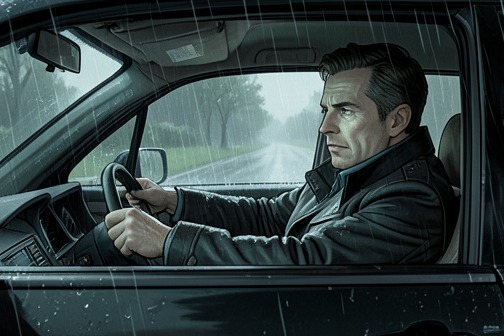
[Ben Givens's planned suicide expedition](entity:event-recall-event-ben-givens-s-planned-su-bd5d44141949) is a quail hunt arranged to conceal his intention to die in the remote sage country. Driven by a terminal cancer diagnosis and his dread of the suffering he expects, Ben disguises the journey as an ordinary outing, even as the hunt begins to expose how sharply his plan conflicts with the life he has lived as a physician, husband, and father. The expedition is therefore both an attempted escape from anticipated pain and a test of the convictions and attachments he has tried to leave behind.
## Background and Decision
Ben understands the force of his diagnosis as a physician as well as a patient. His cancer has spread from his colon to nearby lymph nodes and then to his liver; he believes there is no cure and imagines a decline marked by serious symptoms, dependence, and a prolonged nursing-home death. His medical knowledge, once a source of confidence in treating others, gives him a detailed forecast of what he fears awaits him. He sees no intervention that can stop the disease, and concludes that avoiding its anticipated suffering is preferable to enduring it.
That decision is not presented as a simple rejection of courage. Ben has seen enough pain to believe that it is indifferent to character or virtue, and he doubts that endurance alone makes suffering meaningful. He knows the counterargument: approaching death can intensify attention to ordinary beauty, deepen love, and make lesser troubles recede. But he questions whether such consolations, which he had previously spoken about as a doctor, reflect real knowledge of dying. In his view, extreme pain can overwhelm the arguments made on its behalf. His plan grows from this collision between professional understanding, personal fear, and uncertainty about what a prolonged death would mean.
## A Hunt Concealing Its Purpose
To prevent his family from discovering the plan, Ben tells [Renee](entity:character-recall-character-renee-3bacf4904875) and his grandson [Chris](entity:character-recall-character-chris-6b96eaa1894c) that he is going over the mountains to hunt quail in willow canyons. He gives them an uncertain return date—Thursday, or perhaps Friday or Saturday if the hunting is good—so that they will not immediately search for him. He keeps his terminal diagnosis from them, partly because he fears it would burden a family still emerging from grief after [Rachel Givens's death](entity:event-recall-event-rachel-givens-s-death-d8f28a7fe10c). Their dinner the evening before his departure thus serves two purposes: an apparently ordinary family visit and part of the cover for the expedition.
Ben extends the disguise into his household and equipment. He leaves familiar signs of an unfinished ordinary life, including a bird plucker, an open recipe box turned to quail on toast, a television recording, and a magazine Renee had given him. He packs enough clothing and toiletries to make the trip seem as long as he claims it will be. The details reveal how deliberately he has organized the appearance of a routine hunt, while his promise to go climbing with Chris at [Silver Peak](entity:location-recall-location-9a994bc22a97) after he returns exposes the strain between his spoken future and the private plan he has made.
The practical arrangements also encompass his dogs. Ben imagines setting them free in the sage country before he dies, but worries that they could face hunger, hardship, and death. He hopes they might find another hunter, yet recognizes that leaving them would violate the responsibility he feels toward them. His concern is not incidental to the plan: even while preparing to disappear, he remains bound to the living creatures who depend on him.
## Love, Memory, and the Intended Ending
The expedition carries a second, competing purpose through Ben's memory of a promise made with [Rachel](entity:character-recall-character-rachel-84f0cd683952) on a train from Mantua to Bressanone. They had imagined that their ashes would nourish intertwined roses, one red and one white. The idea had once seemed like a romantic wish; growing older, they had treated it with amusement without relinquishing it. Ben has preserved [Rachel's ashes](entity:object-recall-object-db88d818e917) in the hope that the promise might still be fulfilled. Now he wonders whether dying alone in the sage country would make that future impossible, and imagines his own remains scattered rather than joined with hers.
His planned last meal belongs to the same stark reckoning. He expects to cook a quail over a fire, but sees that it would nourish only what consumes a dead body. The hunt, the dogs, and the roses all make the intended ending concrete in different ways: it would separate Ben from the animals in his care, frustrate a shared promise with Rachel, and reduce a final act of hunting to a gesture without the human relationships that have given his life shape.
## The Hunt and the Plan's Contradiction
After killing birds during the hunt, Ben holds one and attends to its living warmth and patterned feathers. The encounter prompts him to question the circumstances he has chosen. An isolated death after killing small birds, he realizes, seems cruel and inadequate as the conclusion to a life spent as a doctor, husband, and father. He sees the hunt and the landscape as insufficient grounds for his final act, but also recognizes that suicide itself is at odds with his understanding of himself and the world. The conflict does not resolve into an immediate declaration that he has abandoned the plan; rather, the hunt makes its moral and personal contradictions newly visible.
The expedition continues to place that conflict alongside physical illness and fear. In a motel, sharp pain keeps Ben awake, and he uses marijuana given to him by a drifter in search of relief, while worrying that it may cloud his judgment. Later, at a fruit pickers' hut, he cannot tell whether the chill and nausea signal death or exhaustion, with the drug further obscuring his sense of his condition. He recognizes that beneath his outwardly stoic manner he has lived with persistent fear of death. The planned journey therefore does not deliver the certainty he sought: its stages bring relief, confusion, pain, and renewed confrontation with mortality, while the evidence of Ben's attachments continues to trouble the ending he intended.
Event 3
Ben Givens's car crash at Snoqualmie Pass

[Ben Givens](entity:character-recall-character-ben-givens-0e0f37efeae7)’s car crash at [Snoqualmie Pass](entity:location-recall-location-snoqualmie-pass-4703a57712db) turns a dangerous drive into a collision that nearly kills him, then leaves him and [Rex](entity:character-recall-character-rex-63f19e2954a3) alive beside a wrecked [1969 International Scout](entity:object-recall-object-1969-international-sco-52e77e3c67a3). The immediate cause is not simply the rain or the crowded highway: Ben turns away from the road to wrestle with Rex, whose refusal to move from the rucksack occupies his attention at exactly the moment the vehicle begins to slide. The episode sharply reverses the journey’s direction of control. Ben had been intent on crossing the mountains and returning to the country of apple orchards; now he is injured, stranded, and dependent on the young travelers who stopped behind him.
## Setting and Immediate Dangers
The crash unfolds on the climb beyond Humpback Mountain, where the road turns north and rises more steeply. Morning light is only beginning to replace darkness. Rain covers the road and hillsides, while fast, white creeks run through the ravines. Three haul trucks climb in the far-right lane, and cars travel ahead of and behind Ben. The Scout seems at intervals to float over the wet surface before finding its grip again. These details establish the peril before the collision: Ben is driving among heavy vehicles on a rain-slick road, with the windows fogged by the dogs’ breath and limited room to recover from a mistake.
Rex suddenly leaps over the seat and puts his forepaws on the rucksack. Ben is already tense amid the road hazards, and his first response is anger: he believes Rex must learn his place, as [Tristan](entity:character-recall-character-tristan-2fe42552783a) did before him. He tries speaking to the dog in several registers, moving from beseeching words to command and then a gentler threat. When Rex stays put, Ben takes him by the collar and orders him back. The dog whimpers but holds his ground. The exchange gives the crash its immediate human and animal conflict: Ben tries to impose control inside the vehicle while the road demands that he keep his attention forward.
## The Collision
Half-turned in his seat, Ben braces himself against the steering wheel and tries to pull Rex away from the rucksack, his hand locked behind him at the dog’s throat. The Scout begins sliding toward the median before he can correct its course. He releases Rex, swivels forward, and clutches the wheel, but the vehicle is already moving. It hits the concrete barrier, rebounds across all four eastbound lanes, slips between two haul trucks, and goes down the summit exit ramp before striking a small fir tree.
The sequence makes the outcome seem improbable without making it safe: the Scout avoids the trucks, but the collision with the tree leaves it mangled. Two young people who had been driving behind Ben come to his aid. The boy opens the driver’s door and puts a hand on Ben’s shoulder; Ben, holding his head in his palms, cannot say whether he is all right. The boy notices that Ben is bleeding and asks whether he needs a doctor. He later explains that the radiator is gone and the vehicle has no cooling system. The girl emphasizes how narrowly Ben passed between the two trucks, which did not stop. Their account confirms both the near miss and his isolation after it: the traffic that made the drive so perilous continues on, while the two people behind him remain.
## Damage and Aftermath at the Roadside
Ben identifies Rex as the reason he turned, acknowledging that the wet road and the dog’s jump combined to make him lose control. The admission places responsibility neither wholly on the animal nor wholly on the weather; the crash comes from their intersection with Ben’s decision to turn around while driving. The boy and girl look over the Scout, and the boy warns that the damage is extensive. Ben, moving gingerly because his neck and shoulders have stiffened, leans through the driver’s door to retrieve his coat. He searches the rucksack for spare glasses and puts on his hunting cap. The glasses are small, delicate, steel-rimmed ovals he bought in 1954 and has not worn for thirty-three years, a specific remnant of an earlier life brought back into use amid the wreckage.
With the hood open, the damage becomes a chain of broken connections rather than a single visible impact. The radiator has rammed into the fan shroud, splitting and twisting it sideways. The fan has been pushed against the water pump, which is fractured and leaking; the front seal and pulley are bent, and the alternator has torn from its bracket. The battery has tipped against the steering box, cracked and leaking acid. The boy suspects that the frame is torqued, sees a cracked left-front mount, and allows that the block may also be cracked. Together, these failures make clear why the Scout cannot simply continue the journey: the crash has compromised the systems needed to keep the engine running, as well as the vehicle’s structure.
The girl catches Rex by the slack in his collar and strokes his throat and withers. She proposes leaving the Scout and checking out Traveler’s Rest, giving the roadside encounter a practical next step without undoing the damage or the danger that brought them there. The decisive outcome of the crash is therefore twofold: Ben’s intended journey is interrupted, but he survives the collision, as does Rex. The young travelers’ stop turns the wreck from a solitary emergency into a situation in which help is present, even as the disabled vehicle and the rain leave the consequences plainly visible.
## Narrative Significance
The crash converts Ben’s effort to manage the dog into a moment when neither dog nor vehicle responds to command. Rex will not move; the Scout slides; Ben’s attempt to correct the situation comes too late to prevent impact. The collision is a concrete reversal from purposeful movement through the pass to immobility beside the road. Its force lies in the details of that reversal: the trucks keep going, the radiator is destroyed, and Ben must retrieve his coat from a damaged car rather than continue driving toward the orchard country he longs to reach.
The survival of Ben and Rex contrasts with the extent of the wreck. The car has struck a barrier, crossed four lanes, passed between two trucks, and hit a tree, yet both emerge alive. The witnesses call the outcome a miracle, grounding that judgment in the narrow passage between the trucks rather than in any explanation beyond what they saw. The scene thus makes survival contingent and material: the wet pavement, the truck spacing, the barrier, the tree, and Ben’s delayed turn all participate in how the event unfolds. It is the first major interruption to his crossing of the mountains, and it leaves him with a damaged vehicle, a bleeding head, and immediate assistance from strangers.
Event 4
Ben's chukar hunt in the Columbia River breaks
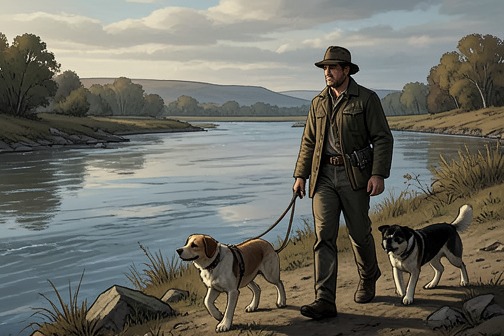
[Ben Givens](entity:character-recall-character-ben-givens-0e0f37efeae7)’s chukar hunt in the [Columbia River](entity:location-recall-location-columbia-river-312c0690a11d) breaks turns a journey shaped by his intention to die into an encounter with the limits of that intention. He crosses into unfamiliar country expecting to hunt, and the first birds he shoots bring both the old competence of a hunter and a sharp recognition that killing birds cannot make a fitting end to the life he has lived as a doctor, husband, and father.
## Setting and Decision
Ben and his dogs reach the west bank of the Columbia River and cross the highway bridge single file. A drifter carries Ben’s duffel while Ben wears his rucksack and keeps the dogs close on their leashes. The river lies broad below them; beyond it, the breaks rise toward the plateau. Ben has not hunted this stretch before, and its unfamiliarity does not dissuade him. Hunting birds in the open air is what he came to do.
The crossing also presents an immediate alternative: the drifter suggests that Ben leave his dogs in the bushes and try to get a ride. Ben refuses. He has changed his mind, he acknowledges, and chooses to hunt the chukars instead. The decision is a real turn in the journey, but not yet a renunciation of his larger plan. He chooses an activity that belongs to the life he knows without resolving what he will ultimately do.
## The First Covey
Ben encounters his first chukars in the early evening, when the birds are feeding along a ridge crest. He hears their calls before the dogs locate their scent and pauses to work out where the covey is. [Tristan](entity:character-recall-character-tristan-2fe42552783a) grows alert and moves toward the breeze; [Rex](entity:character-recall-character-rex-63f19e2954a3) follows the scent down into the breaks. As the calling stops, Ben moves between the dogs, prepares for a possible flush, and accounts for the low sun that may face him when the birds rise.
Tristan eventually points, and the dogs move again as the birds flush. When they go on point together in high bunchgrass, Ben takes the safety off his shotgun and steadies himself. The moment carries a hesitation he recognizes from a lifetime of hunting: even as a child shooting mourning doves with his father, he had felt doubt before taking a bird’s life. After the war, when killing had become part of his experience, he stopped hunting and fishing altogether. Following [Rachel](entity:character-recall-character-rachel-84f0cd683952)’s death, he returned to hunting, and in the previous two autumns had again shot small birds and waterfowl. The scene thus joins a childhood practice, a postwar refusal, and a bereavement-era return to killing.
A chukar rises near Rex, and Ben shoots. More birds break from cover, and he fires again at a bird that climbs away wounded. He is startled by how well he has shot despite having the use of only one eye; that success feels less like reassurance than an injustice to the birds brought down by his father’s gun. He hunts farther downhill, misses once, and then takes other birds. One flushes from behind a stone tower and approaches on a steady line below his gun before he shoots it as it moves away.
## Recognition and Reversal
Holding the last bird, Ben attends to its patterned feathers and the warmth still in it. The encounter makes the circumstances of his planned death newly legible to him: he had imagined dying alone in arid sage country after killing small birds, but can no longer regard that as an adequate conclusion. The hunt and the land do not supply a sufficient reason for the end he chose. He sees the plan as a form of stoic machismo, and recognizes that both hunting as a final earthly act and taking his own life conflict with the life he has lived and the understanding he has of himself and the world.
This recognition does not arise from a speech or a rescue, but from the action he had sought: he hunts, shoots, and then holds a bird in his hand. The scene makes the intended ending feel misdirected by setting the physical fact of a dead bird against Ben’s identities as a physician, husband, and father. His competence has not settled the moral question of killing; instead, the successful hunt clarifies why the proposed final act cannot serve as a meaningful answer.
## The Hunt’s Immediate Aftermath
Ben puts the bird in his coat pocket and climbs the breaks in the failing light, feeling pain and fatigue. The dogs are nearby, but he is too weary to pay attention to them as he makes his way upward. He cannot manage the long walk back into [Vantage](entity:location-recall-location-65ae5c08dceb), so he waits for his condition to improve. When it does not, he climbs in stages until he reaches his rucksack.
The hunt therefore ends without a clean return or a completed resolution. Ben has not yet turned his recognition into a fully stated decision to abandon his plan, and the physical demands of the landscape remain. But the value of the journey has shifted: what began as an attempt to make hunting and death coincide has exposed the inadequacy of that design. The bird in his pocket is both the result of the hunt and the concrete occasion for reconsidering what kind of ending his life can bear.
Event 5
Lenora Givens's death
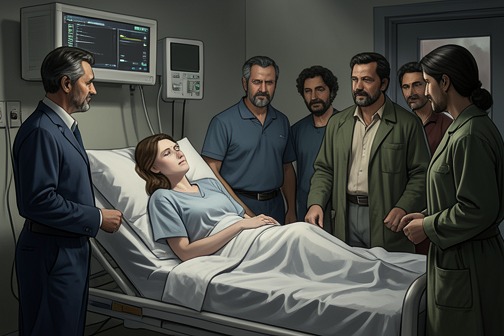
[Lenora Givens's death](entity:event-recall-event-lenora-givens-s-death-93f74ce46398) from pancreatic cancer in 1938 was a defining loss in [Ben Givens](entity:character-recall-character-ben-givens-0e0f37efeae7)'s childhood and a lasting reference point as he faced terminal illness himself. Her final days brought together the limits of medicine, the burden of pain, and her conviction that raising her sons was work she had not yet completed. The memory does not resolve those tensions: it preserves both her fear and her faith, and the family and community gathered around her as she died.
## Background and Diagnosis
[Lenora Givens](entity:character-recall-character-lenora-givens-33fc88503072)'s beliefs were closely tied to work and family. A committed Presbyterian, she understood work as an expression of love for God and as a means through which people came to know themselves. She had taught her sons that a life contained worthy tasks fitted to a person's purpose. That conviction gives particular weight to her later feeling that her own work remained unfinished.
Ben Givens was twelve, just after Christmas, when he noticed a yellow cast in his mother's eyes. She had noticed it too and had already been urged by her husband, [Wright Givens](entity:character-recall-character-wright-givens-b9bebac323cd), to consult [Dr. Williams](entity:character-recall-character-dr-williams-1287b5da0ec7). At first, the cause was uncertain. After New Year's, Dr. Williams examined her again as the change became more pronounced, and by February she had also seen specialists in Spokane. The family eventually learned that she had pancreatic cancer and could not be cured. The diagnosis brought a clear limit to the doctor's power: Ben, still a child, challenged the news on the grounds that Dr. Williams was a doctor, while the physician acknowledged that medicine could not make him a magician or cure her.
## Care and the Limits of Relief
As Lenora Givens's condition worsened, she spent much of her time resting at home. Dr. Williams visited twice a week to provide tincture of opium. The family faced not only the certainty that she would die but also the uncertainty of how much pain she could bear and how much medication was appropriate. When Wright Givens asked whether there was an amount that would be too much, Dr. Williams left the decision to the family's judgment. The exchange offers no simple medical answer; it records the distress of having to make decisions at the edge of what treatment could accomplish.
Care was shared among neighbors, churchwomen, and the family. Mrs. Emery came first, followed by Mrs. Fisk and Mrs. Elginhurst, while women from the church took turns helping during the day. After orchard work, Ben Givens, [Aidan Givens](entity:character-recall-character-aidan-givens-82b9c7406e11), and Wright Givens took over in the evenings. The arrangements made Lenora's last illness a sustained family and community responsibility rather than a private event. She often looked out toward the trees and river, while those around her continued the practical work of caring for her.
Lenora Givens acknowledged both faith and fear. She told Ben Givens that she believed in God but was frightened, particularly of pain. She also explained that the problem was not simply being confined indoors: she missed the world, and felt that her work on earth—raising Ben and [Aidan](entity:character-recall-character-aidan-8244a7bd0185)—was unfinished. Ben suggested taking her bed outside, but her answer made clear that a change of setting could not address what troubled her. The exchange connects her religious understanding of purposeful work with her attachment to her children and her awareness that her life was ending.
## Death and Burial
Later that week, Lenora Givens died at 6:35 in the morning on June 28, 1938. Ben Givens, Aidan Givens, and Wright Givens were beside her, sitting on kitchen chairs brought into the room. As her breathing stopped, Wright Givens leaned close and said her name. The account marks the death through this intimate family vigil, after the uncertainty and repeated care of the preceding weeks.
She was buried on a knoll above the river. Relatives, neighbors, and members of the surrounding community attended, including the Fisks, Coles, Robinsons, Knoxes, Elginhursts, Emerys, and Dr. Williams. Twenty-three members of the Givens family came from communities along the river, from Kennewick to Kettle Falls. A thunderstorm passed over the grave that evening. The funeral thus joined the family's private loss to the wider network of people who had known them and helped during Lenora Givens's illness.
## Aftermath and Continuing Memory
The following summer, the family worked the apples with a hollow feeling, and the orchard fell into decline. The loss changed the texture of ordinary labor: work continued, but it no longer carried the same assurance of continuity. Wright Givens spent long hours hunting birds in the willow canyons and returned at dusk to prepare what he had brought home. These details register the altered household after Lenora Givens's death without suggesting that grief followed a single course or disappeared when daily tasks resumed.
Years later, Ben Givens's own diagnosis made his mother's illness newly immediate. As a physician, he understood the progression of his cancer and the suffering he expected; the knowledge did not make death controllable. His recollection of Lenora Givens's fear of pain and the family's dependence on limited relief sits beside his own deliberations about how to face a terminal illness. The parallel is not an equivalence between their circumstances: it shows how the experience of caring for his dying mother remained part of the knowledge through which he understood his own prognosis.
Her death also shadows Ben Givens's professional identity. He had once approached medicine as a physician able to intervene, while recognizing that some outcomes lay beyond his command. The childhood memory had already shown him a doctor stating plainly that a patient's cancer could not be cured and a family confronting the decisions that followed. In that sense, Lenora Givens's illness is both a personal bereavement and an early encounter with the boundary between medical skill and mortality. Its lasting force comes from the particular things left unresolved: the pain she feared, the work she believed unfinished, and the care her family could offer without being able to save her.
Event 6
Rachel Givens's death
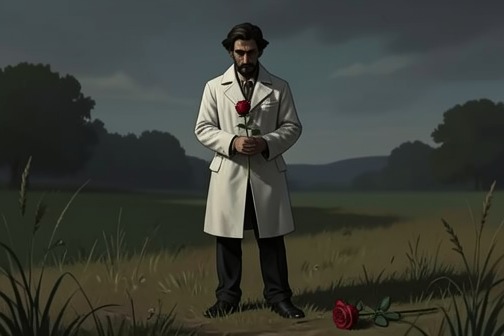
[Rachel Givens](entity:character-recall-character-rachel-givens-956a2a6531cb)’s death is the loss that reshapes [Ben Givens](entity:character-recall-character-ben-givens-0e0f37efeae7)’s life and gives their promise about roses its lasting force. The novel approaches the event through memory rather than a detailed account of the death itself: it establishes that [Rachel](entity:character-recall-character-rachel-84f0cd683952) has been dead for nineteen months, recalls the couple’s vow to have their ashes nourish red and white roses, and returns to their final conversation before her surgery. The circumstances of her death are not specified, but its consequences are visible in Ben’s altered work, habits, and hopes.
## Loss and Its Aftermath
By the time of the novel’s present, nineteen months have passed since Rachel Givens died. Ben Givens has turned away from his work as a surgeon and has too much idle time; after Rachel’s death, he takes up hunting birds to shoot on the wing, a pursuit he had not followed since he was a teenager. The change is more than a new pastime: the loss interrupts a life organized around medical work and gives his days a different, haunting occupation.
The novel does not narrate the death as a completed medical scene or state its cause. Instead, it places the reader near its approach through Ben’s recollection of Rachel’s final hours before surgery. That boundary matters: the remembered exchange shows what the couple said and feared, while the death itself remains beyond the scene’s account.
## The Promise of the Roses
The promise reaches back to a train journey from Mantua to Bressanone. Rachel and Ben imagined their ashes becoming the bed for two roses, his red and hers white, growing together and eventually intertwining. As they grew older, they were amused by the youthful, romantic idea but did not abandon it. After Rachel’s death, Ben preserves her ashes in the hope that their vow can still be fulfilled.
The image joins bereavement to a future imagined as shared. Rachel’s death has separated the couple, but the promised roses make that separation neither simple nor final in Ben’s understanding: he continues to hold open the possibility that their remains will nourish a single living growth. His recollection of the vow is also a measure of what he stands to lose if he chooses a death that would prevent its fulfillment.
## Rachel’s Final Reminder
The promise returns in Rachel’s last conversation with Ben, the day before she died and two hours before her surgery. She reminds him of their colors—Ben as red, Rachel as white—and asks him to remember the roses and her love if she dies, while making clear that she is not planning to die. The words hold hope and contingency together: Rachel faces the possibility of death without presenting it as her expectation.
Ben answers her fear with professional certainty, telling her that the mortality rate for a mitral-valve replacement in someone in her condition is approximately one in a billion and assuring her that she will be fine. The exchange brings his identities as husband and heart surgeon into direct contact. He offers the confident prognosis of a doctor, while Rachel asks him to carry forward a private promise that no prognosis can guarantee.
## Significance in Ben’s Life
Rachel’s death is present through recurring consequences rather than a full account of its circumstances. It marks the beginning of Ben’s withdrawal from surgical work, precedes his return to bird hunting, and leaves him guarding Rachel’s ashes for the sake of their shared plan. The roses give that grief a concrete form: a remembered vow that joins love, death, and the possibility of growth after loss.
The scene before surgery also places the limits of Ben’s medical confidence beside the intimacy of the couple’s promise. He can state a mortality estimate and try to reassure Rachel, but the narrative’s later confirmation of her death makes clear that reassurance did not prevent the loss. What remains is the request she entrusted to him: remember the roses, and remember her love.
Event 7
Ben Givens joins the 10th Mountain Division
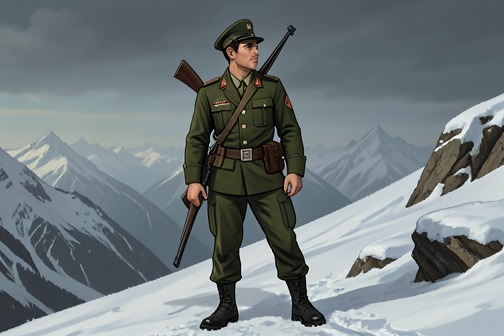
[Ben Givens](entity:character-recall-character-ben-givens-0e0f37efeae7)’s decision to join the [10th Mountain Division](entity:organization-recall-organization-10-3c2286d23575) turns a letter about skiing into a departure for war, and makes visible the cost of that choice at home. Recruited through his experience in the mountains, he chooses a particular form of Army service rather than waiting for the draft to decide his fate. But enlistment is not presented as a clean break from family: his father accepts the logic of going while pleading for the son he needs to remain.
## The Call to the Mountain Troops
In May, a letter arrives from Willard Anderson, president of the Leavenworth Ski Club. Anderson remembers Ben passing on the jump at Ski Hill and writes to invite him into a military unit organized around the high country. The [87th Mountain Infantry Regiment](entity:organization-recall-organization-87-c2c7797c8e41), he explains, was activated at Fort Lewis the day after [The attack on Pearl Harbor](entity:event-recall-event-the-attack-on-pearl-har-f18467788d14) and had trained on the slopes of Mt. Rainier. The 10th Mountain Division followed, and it is now recruiting, with help from the [National Ski Patrol](entity:organization-recall-organization-6e12f104a9d1). Anderson’s appeal rests on a close fit between Ben’s enthusiasm for the mountains and the Army’s need for men able to serve in them.
The letter also frames the choice as a way to retain some agency under conscription. Anderson contrasts joining the mountain troops with simply going wherever the draft sends Ben, urging him to “meet the war on your own terms, and wearing skis as well?” The appeal does not offer a way out of the war; it offers a way to enter it on terms connected to a life Ben already knows. The skis in Anderson’s formulation make military service sound at once practical and personal: the familiar skill becomes the means by which Ben approaches an unfamiliar obligation.
## Acceptance and Family Resistance
Ben’s father does not reject the idea that his son may have to serve. He says that if Ben must go, he may as well go as a mountain trooper. Yet that practical concession immediately gives way to a more intimate plea: “I wish you wouldn't go at all,” he says. “I wish you could stay. I need you.” Ben answers, “You'll get along.” His father replies, “No, I won't.” The exchange makes the family cost plain without turning it into an argument Ben can resolve. His father can recognize the sense of the choice and still fear the loss of his presence.
The Army’s order makes the possibility concrete. One afternoon, a letter from the adjutant general’s office in Washington directs Ben to report for active service in the 10th Mountain Division. He reads it twice, and his heart begins to pound. He then goes to find his father in the south orchard, where he is laying new irrigation pipe. The setting holds the decision against ordinary farm work: the Farmall has been hauling pipe, the day is clear, windless, and hot, and the orchard shade is pierced by the afternoon light. His father shuts off the tractor and reads the letter. His first response is only, “Well.” Ben tells him, “I'm all accepted.”
They lean against the Farmall while his father reads the order again. Afterward, he says, “I don't like this,” and “I don't want you to go.” He puts a hand on Ben’s shoulder and squeezes, then says that it does not seem right for Ben to go off to fight a war. Ben’s answer is that he has to go anyway. His father points out the fact that sharpens the exchange: “You're seventeen.” The enlistment is thus marked both by official acceptance and by the youth of the person being sent away.
## Joining and the Coming Departure
The later conversation with another person reduces the decision to its plainest terms. Asked what he will do, Ben answers, “I joined up.” Asked when he goes, he says, “End of October.” The exchange confirms that the letter and the family conversation have become action: he has joined, and a departure is approaching. The evidence establishes the end of October as the time he expects to go, while the order itself is the formal instruction to report for active service.
The event’s emotional shape comes from the difference between Ben’s concise statements and his father’s repeated resistance. Ben says he has been accepted and that he has to go; his father says he does not want him to leave and needs him at home. Neither response cancels the other. The enlistment proceeds without a triumphant farewell or a reconciliation that makes the separation easy. Instead, the decision stands in the space between an obligation Ben accepts and a father who cannot accept its cost.
## Retrospective Significance
The episode joins Ben’s mountain experience to the larger historical demands of war, but it also preserves the small, specific circumstances through which that history enters a family: a recruiting letter, an order read twice, irrigation pipe, a shut-down Farmall, and a hand squeezed onto a shoulder. The contrast between the Army’s formal language of active service and the father’s direct declaration of need gives the decision its human scale. The division offers Ben a chosen route into service; it cannot make that service any less a departure from the orchard and the people who depend on him.
The novel later shows Ben working in other demanding forms of care: assisting [Ilse Peterson](entity:character-recall-character-ilse-peterson-8c86c0cf4bad) with surgery on [Rex](entity:character-recall-character-rex-63f19e2954a3), assessing a seriously ill orchard worker while acknowledging the limits of what he can diagnose without equipment, and confronting an obstructed labor decades after his obstetric internship. Those later scenes do not establish that his military service caused his medical expertise. They do, however, place this youthful decision within the longer account of a life repeatedly called toward difficult responsibilities. At seventeen, Ben answers the call of war through the skills associated with the mountains; his father’s plea ensures that the choice remains, at its center, not an abstraction about service but a painful departure from home.
Event 8
The attack on Pearl Harbor

[The attack on Pearl Harbor](entity:event-recall-event-the-attack-on-pearl-har-f18467788d14) is a historical turning point in the novel’s background: it marks the start of the wartime circumstances that draw [Aidan](entity:character-recall-character-aidan-8244a7bd0185) toward conscription and bring Ben an opportunity to join the mountain troops. The attack itself is not staged; its significance emerges through the changes in military service and family life that follow.
## Wartime Context
Fifteen months after the attack, Aidan was drafted into the Army. Three days before leaving, he packed his bag and asked for one last ride in the [Colockum Country](entity:location-recall-location-eca2f7ac83de) with Ben. Their dawn departure, crossing the river at Coleman’s Landing and riding through the day, gives the broad historical change a personal measure: military mobilization arrives in the middle of a life shaped by horses, hunting, and the family orchard.
## Expansion of the Mountain Troops
A letter Ben received in May from Willard Anderson, president of the Leavenworth Ski Club, placed the attack in the history of the Army’s mountain forces. Anderson wrote that the [87th Mountain Infantry Regiment](entity:organization-recall-organization-87-c2c7797c8e41) had been activated at Fort Lewis the day after the attack. After training on the slopes of Mt. Rainier and other advances, it was followed by the [10th Mountain Division](entity:organization-recall-organization-10-3c2286d23575), then recruiting with help from the [National Ski Patrol](entity:organization-recall-organization-6e12f104a9d1). Anderson urged young men drawn to high country to join; he presented voluntary service as a way to meet the war on terms suited to their experience, rather than simply going wherever the draft sent them.
## Consequences for the Givens Family
The attack’s effects reach the family through different forms of departure. Aidan faces a draft; Ben is invited to choose a specialized military path. Ben’s father supports the mountain-troop option if Ben must serve, yet tells him he wishes he would stay because he needs him. The historical event therefore functions less as a battle scene than as pressure on an intimate household: war expands the Army, redirects the sons’ futures, and makes the possibility of separation immediate.
Event 9
The 1929 stock market crash
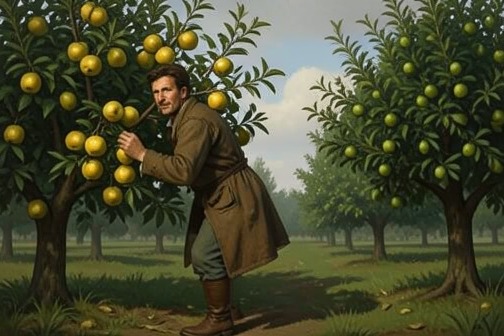
[The 1929 stock market crash](entity:event-recall-event-the-1929-stock-market-c-1c87fdeb5687) is recalled as the financial reversal in the story of the boys’ maternal grandfather, James Chandler. Rather than narrating the crash itself, the account places it beside the family’s earlier prosperity and Chandler’s success as a fruit grower, making the collapse part of an inherited history of achievement and loss.
## Family Prosperity Before the Crash
[Wright Givens](entity:character-recall-character-wright-givens-b9bebac323cd) recounts that James Chandler patented the Rainier Delicious apple. Chandler had bought two dozen seedling trees from a peddler passing through [Wenatchee](entity:location-recall-location-b0a40ebd989a); they proved to be Golden Reinettes from Virginia. After a windfall seedling produced unusually large, mild-yellow apples, Chandler bought the rights to propagate it and promoted the variety vigorously. He even built an iron cage around the tree to guard its bud sticks.
The account gives that horticultural success public markers: the American Pomological Society awarded Chandler its Wilder Medal in 1921, and in 1926 a carload of his apples was sent to the St. Louis Cardinals after their World Series victory. These details establish the scale of the family’s earlier standing before the recollection turns to the stock market.
## Investment and Reversal
Wright says that the boys’ grandfather had once been wealthy but invested with too much confidence in the stock market before it crashed in 1929. The passage does not describe what Chandler bought, how much he lost, or the mechanics of the crash. It does, however, place his former fortune beside an overconfident investment and the ensuing collapse, marking the crash as the threshold after which that wealth belonged to the past.
## Place in the Family Story
The crash reaches the reader through Wright’s account of family history, not through a narrated market scene. Its significance lies in the contrast the recollection constructs: Chandler’s painstaking cultivation and promotion of a successful apple variety stand alongside a fortune exposed to financial risk. As Wright tells the story, [Ben Givens](entity:character-recall-character-ben-givens-0e0f37efeae7) asks him to continue, while [Aidan Givens](entity:character-recall-character-aidan-givens-82b9c7406e11) has fallen asleep by the fire; the market collapse is thus one part of a longer family narrative being handed on in conversation.
Event 10
Ben Givens's suicide attempt
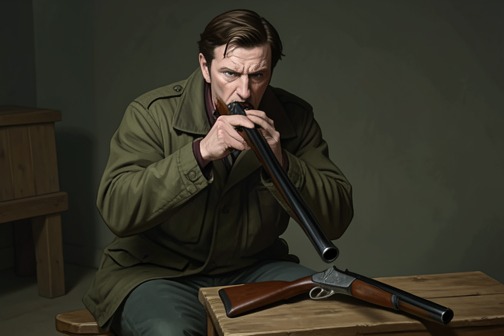
[Ben Givens's suicide attempt](entity:event-recall-event-ben-givens-b29e96f8b819) is disclosed through the gun he carries into the desert: earlier that morning, he had put his father's shotgun in his mouth. The act makes his later pursuit of his dogs more than a test of endurance. The weapon is both a family possession and the instrument of an intended death, while Ben's regret at having ever held a gun registers a brief recoil from the violence he has made part of his plan.
## The Earlier Attempt
As Ben prepares to follow his dogs, he loads two shells into his side-by-side shotgun. The scene identifies it as his father's gun and recalls that Ben had put it in his own mouth earlier that morning. The attempt itself is not staged; it enters the present as a blunt fact attached to the weapon. Ben has survived and is moving again, but the gun keeps the possibility of suicide physically close.
For a moment, he regrets every gun he has ever held. That hesitation does not become a declared renunciation: he shakes it off, packs his blanket and poncho, straps them to his rucksack, and sets out after the dogs. The contrast is consequential. The same hands that load the shotgun and shoulder the pack have handled a weapon as a means of self-destruction, yet Ben continues into the desert rather than remaining still with the thought.
## The Plan Returns
The later account shows that the attempt has not ended Ben's suicidal intention. He arranges travel upriver by calling [Greyhound](entity:organization-recall-organization-greyhound-56ca3151d772) Bus Co. and reserves a rental car from a [Wenatchee](entity:location-recall-location-b0a40ebd989a) company. He intends to drive to [Malaga, Washington](entity:location-recall-location-malaga-washington-6e73eb94dd16), find [William Harden](entity:character-recall-character-william-harden-4221759a3ef2)'s [Wolfhound Orchard](entity:location-recall-location-wolfhound-orchard-bf71e139e4af), and somehow recover his gun. Afterward, he plans to walk for grouse in the Colockum country, find a barbed-wire fence, and shoot himself in the neck.
Recovering the weapon is not a simple matter of asking for it back. Ben expects Harden to refuse a direct appeal based on ownership, fair play, or another apology for the wolfhound's death. Nor can he imagine taking the gun by burglary or theft. The practical obstacle sharpens the plan's disturbing dependence on the very object Ben briefly regretted: his intended next step requires him to get the gun back.
## Significance in the Narrative
The attempt is revealed retrospectively while Ben is already pursuing his dogs across moonlit prairie. His shotgun seems dreamlike in the silver light, an impression intensified by the marijuana whose effects later confuse him as he follows wheel ruts and tries to locate the dogs. Yet the recollection is exact where it matters: this is the gun he had put in his mouth. The image binds altered perception to an unmistakable fact of danger.
The event therefore marks neither a completed departure from life nor a settled recovery. Ben continues to travel and act, but his later itinerary still ends in a deliberate death, and the weapon remains central to it. His momentary regret interrupts that trajectory without resolving it; the attempt's force lies in the interval between the act already survived and the plan he is still trying to carry out.
Event 11
Car crash at Snoqualmie Pass
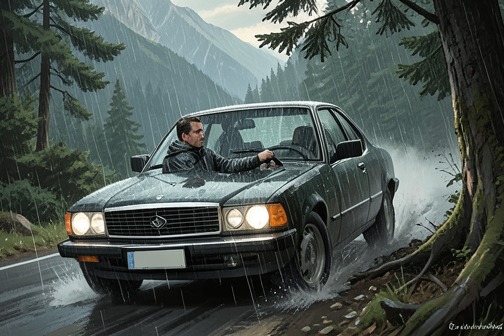
The [Car crash at Snoqualmie Pass](entity:event-recall-event-3d4159f1d877) is the sudden physical rupture in [Ben Givens](entity:character-recall-character-ben-givens-0e0f37efeae7)’s journey: as he tries to control [Rex](entity:character-recall-character-rex-63f19e2954a3) in the rain, the [1969 International Scout](entity:object-recall-object-1969-international-sco-52e77e3c67a3) skids across the highway and into a tree. The crash nearly kills both of them, but Ben survives—and, instead of continuing alone toward the death he had contemplated, chooses to stay for Rex’s care. A journey shaped by deliberate surrender is redirected by a moment in which Ben loses control and is given another chance to act.
## Causes and Setting
Ben is driving beyond Humpback Mountain, where the road turns north and climbs more steeply. Early morning has brought only low gray light; rain slicks the pavement and makes the hillsides glisten. Red huckleberry brush and vine maples mark the slopes, while fast, white creeks run through deep ravines. The road itself is crowded with hazards: three haul trucks climb in the far-right lane at about thirty miles an hour, and cars travel both behind and ahead of him. The windows are fogged by the dogs’ breath. Ben slows to forty and leans forward, alert to the wet road, the trucks, and the traffic.
The danger is tangible before anything goes wrong. The Scout seems, in brief intervals, to float as its wheels spatter through water, then to seize the road again. That alternating grip and drift gives the car’s movement an unstable rhythm: the vehicle is at once his means of crossing the pass and an object whose response he cannot entirely command. Ben’s immediate problem, however, is Rex. The dog suddenly vaults over the seat and settles his forepaws on the rucksack. Ben is already managing a hazardous road; now he tries to make Rex understand his place, as [Tristan](entity:character-recall-character-tristan-2fe42552783a) had before him.
The urgency of the scene sits against Ben’s larger purpose. He has considered allowing himself to die in the mountains, imagining hypothermia as a passive way to let life end. Yet when the mountains beckon, he turns away from them and continues toward the country beyond, the world of apple orchards where he was born. The crash occurs in that movement away from the mountain landscape and toward home. It does not resolve his underlying crisis, but it interrupts the plan at its most immediate level: Ben must respond to an accident, his injuries, and the dog beside him.
## The Skid and Collision
Ben first speaks to Rex beseechingly, then with command, then in a low, threatening gentleness. When none of this moves the dog, he grips Rex by the collar and orders him back. Rex whimpers but holds his ground. The conflict is small in scale but consequential in timing: Ben turns partly in his seat, braces against the steering wheel, and reaches behind him to pull the dog away from the rucksack. As he does so, the Scout begins sliding toward the median.
Ben releases Rex and swivels forward, but the car is already skating. It strikes the concrete road barrier, rebounds across all four eastbound lanes, slips between two haul trucks, and descends the summit exit ramp before slamming into a small fir tree. The rapid chain of movements strips away the distinction between driving and being carried by the road. Ben’s effort to restore order inside the car has left him unable, at the critical instant, to correct its course; when he turns back, the vehicle’s momentum takes over.
The wreck also makes the danger of the pass visible to witnesses who had been following behind. A boy opens the driver’s door and asks whether Ben is all right. Ben, holding his head in his palms, cannot say that he is. The boy notices that he is bleeding badly and offers help and a doctor. Later, he describes the Scout as wrapped around a tree and says its radiator is gone, at least, so it has no cooling system. The assessment is practical and immediate: the vehicle is not simply shaken or delayed but badly damaged and no longer usable for the journey.
## Survival and Immediate Aftermath
The boy and a girl who were traveling behind Ben emphasize how narrowly he escaped. They saw the Scout slide between two huge trucks, which continued on without stopping, and describe his survival as a miracle. Their account gives the near miss an outside witness: Ben has experienced the crash from inside a sliding vehicle, but the young passengers can see the path he could not. Their astonishment does not undo the physical facts—the tree, the damaged radiator, Ben’s bleeding—but sets his survival against the apparent likelihood of catastrophe.
Ben explains that Rex’s jump drew his attention and that the wet road caused him to lose control. His account identifies the chain of events without shifting responsibility onto the dog: Rex moved, Ben turned, and the Scout slid on the rain-soaked pavement. The scene’s reversal is stark. Ben had imagined death as something he could allow to happen without directly taking his life; now death comes as an uncontrolled possibility, in a collision he did not intend. The distinction between passively surrendering and actively surviving is no longer abstract. He is hurt, the car is wrecked, and Rex needs help.
The next day, Ben tells [Ilse Peterson](entity:character-recall-character-ilse-peterson-8c86c0cf4bad) that he was in a car wreck. Although she remarks that he does not look like anyone’s idea of a surgeon, he identifies himself as a thoracic surgeon and agrees to assist with Rex’s treatment. Peterson needs help with extensive resuturing, anesthesia, and intravenous support; the procedure will take two or three hours and cost between one hundred fifty and three hundred dollars. Ben accepts the responsibility, including signing the consent form, and says he wants to stay. The accident thus leads not only to survival but to a concrete choice: Ben uses his medical skill and remains with Rex rather than treating the wreck as a reason to abandon the dog.
## Narrative Significance
The crash places Ben’s vulnerability in direct contact with material circumstances. Rain, traffic, fogged windows, a resisting dog, a steering wheel, a barrier, and a tree form a precise chain of causes; the crisis does not arrive as an omen detached from ordinary action. The 1969 International Scout, which had carried Ben toward the country he hoped to reach, becomes useless at the roadside. That change in the vehicle’s function makes the journey’s danger unavoidable and forces Ben into the present tense of injury and care.
The event also complicates the relationship between Ben and Rex. In the car, Ben is angry because he believes the dog must learn to stay back; the attempt to enforce that order contributes to the loss of control. But once the wreck has happened, Ben names Rex’s jump as the cause he understands, and the following day he remains for the dog’s treatment. The movement from command to care is not presented as a clean reconciliation or a sudden cure for Ben’s despair. It is a consequential action within the crisis: despite his injuries and the damaged vehicle, he chooses to help the animal whose movement helped precipitate the accident.
The pass therefore becomes a threshold in both the practical and emotional sense. Ben enters it in a journey bound up with thoughts of death, but leaves the wreck alive, with Rex still needing him and his own professional identity newly put to use. The witnesses’ language of miracle gives the survival its public description; Ben’s decision to stay gives it an immediate human consequence. The crash does not settle what he will ultimately choose, but it interrupts the solitude of his plan and begins a sequence in which attention turns outward, toward another living being.
Event 12
Wolfhound attack on Frenchman Mountain
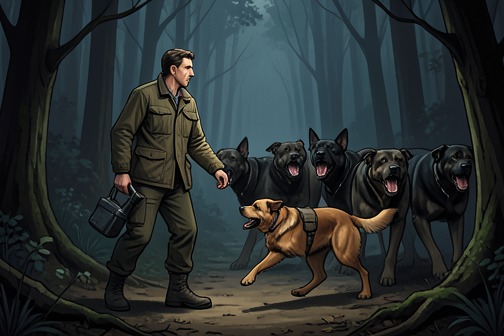
The wolfhound attack on Frenchman Mountain is a turning point in [Ben Givens](entity:character-recall-character-ben-givens-0e0f37efeae7)’s journey: a rescue that forces him to use lethal violence is followed by the discovery that [Tristan](entity:character-recall-character-tristan-2fe42552783a) is dead. The danger begins with the pack pursuing a coyote, but when the hounds turn on [Rex](entity:character-recall-character-rex-63f19e2954a3), Ben can no longer remain an observer. His intervention saves Rex from the immediate attack, while the later discovery of Tristan’s death makes clear that the encounter has already cost him the older dog he had brought into his life as a companion.
## The Pack and the Pursuit
Under the full moon, Ben searches a draw crowded with sumac and willows after hearing the hounds. He cannot see them at first, but their noise convinces him that a coyote is being driven from its refuge. He calls for Rex and Tristan, uneasy that neither answers and distrustful of the dogs he can hear below. His concern for his own dogs is therefore present before he sees the attack: the hounds’ pursuit already sounds cruel to him, and he fears the consequences of their proximity.
A coyote breaks out of the thicket close to Ben and changes direction when it becomes aware of him. A much larger wolfhound follows, and four more hounds emerge; Rex is among them. The coyote runs into the sage, with the dogs closing the distance. When it turns to face the pack, several hounds bring it down. Rex then drives into the fray. The sequence shifts the scene’s central danger: what began as a pursuit of a wild animal now places Ben’s dog among the attacking pack.
## Ben Intervenes to Protect Rex
Ben sees the hounds turn from the coyote toward Rex. They force him down and hold him there, and Ben rushes toward them with his shotgun. He first fires a warning into the air. The pack largely stops, but one hound continues to attack Rex, leaving Ben unable to end the danger through warning alone. He strikes and kicks at the animal, yet it does not release Rex.
With Rex still under attack, Ben presses the barrel of his Winchester against the hound and fires. The action is presented as an urgent choice, not a return to easy confidence with weapons. The narration emphasizes that Ben has resisted acting this way in the years since the war ended. Here, however, the immediate stakes are his dog’s life, and he acts without pausing to reconsider the destructive force he has set in motion. Afterward, he turns directly to Rex, kneeling beside him rather than dwelling on the shot.
## The Rider Leaves; Ben Stays
A dirt bike approaches while Ben is struggling to reach the dogs. Its rider challenges him over the weapon and leaves with the pack of wolfhounds following. The departure does not resolve the scene for Ben: the rider moves away, but Ben has already turned from the confrontation to care for Rex. The contrast is stark. The rider treats the encounter as a contest involving a gun and imagined bullets; Ben’s attention is on the injured dog at his side.
The scene thus separates force from responsibility. Ben’s use of the shotgun is violent, but its immediate purpose is to stop the hound attacking Rex. Once that threat is interrupted, his role changes at once: he kneels beside his dog as a doctor. The rider’s departure leaves Ben alone with the consequences rather than offering any help or repairing what has happened. The attack’s human confrontation recedes; care for Rex becomes the work that remains.
## Finding Tristan
With daylight, Ben goes in search of Tristan. He has known the older dog for ten years, having brought him home at seven weeks not as a hunting dog but because he wanted a dog in his life, a remnant of childhood. He remembers Tristan’s long decline through illness and old age, and the way he grew slower and increasingly needed to rest. Ben had brought Rex home in the hope that the younger dog could learn from Tristan before the older companion died. That history makes the search more than a search for a missing hunting partner: Ben is looking for a dog whose life with him spans a decade.
Ben finds Tristan dead at the base of a willow. The discovery confirms the loss he had feared while calling into the dark. He carries the dog to the sageland and digs a shallow grave with the entrenching tool in his rucksack. Though he has little strength left, he gives Tristan a place to rest, kneels beside the grave, closes the dog’s eyes, and covers him with sand. This burial is modest, but it is a deliberate act of care after the violence of the night.
## Significance
The attack brings two distinct losses into the same sequence: Ben must act to protect Rex, and afterward he finds that Tristan has been killed. The contrast between the dogs matters. Rex is the younger companion Ben hoped Tristan might teach; Tristan is the older dog he once brought home simply because he wanted a dog in his life. The attack therefore threatens the future Ben had imagined for Rex while ending, abruptly and violently, the companionship associated with Tristan.
The episode also joins Ben’s past and present through his use of the gun. His years of resistance to violence do not prevent him from firing when Rex’s life is in immediate danger, but the act does not become a triumph. The narrative moves from the shot to Ben kneeling beside his dog, and from that urgent care to the later search and burial of Tristan. In this order, protection does not undo loss. Ben can intervene in one crisis, but he cannot recover the companion he finds beneath the willow.
Event 13
Rex's emergency surgery in Quincy
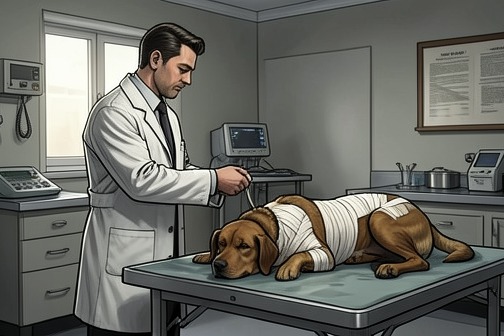
[Rex](entity:character-recall-character-rex-63f19e2954a3)’s emergency surgery at the [Quincy Veterinary Clinic](entity:location-recall-location-quincy-veterinary-cl-538f150fed14) is both a painstaking repair of a badly wounded dog and a sharp reversal in [Ben Givens](entity:character-recall-character-ben-givens-0e0f37efeae7)’s immediate course: after a car wreck and a journey on which he had intended to die, Ben finds himself scrubbing in to help save a life. [Ilse Peterson](entity:character-recall-character-ilse-peterson-8c86c0cf4bad)’s veterinary work gives his medical skill a new, urgent use, while Rex’s treatment ends not with certainty but with a guarded prospect of hunting again.
## Arrival and Decision to Help
When Ilse Peterson sees Ben, he explains that he was in a car wreck the previous day. Rather than press him for the full story, she tells him she needs help: Rex will require substantial resuturing, anesthesia, intravenous support, and a signed consent form. She estimates two or three hours of work and a cost of $150 to $300. Ben says he will stay because he wants to, and offers to do whatever he can.
The decision carries particular weight because Ben had not expected to be caring for anyone. He removes his field jacket, rolls up his sleeves, and washes his hands. His last operation had been nineteen months earlier, when he repaired a failing human heart; this time he is assisting a veterinarian with a dog. He feels a flicker of excitement at returning to surgical work. The contrast is stark: at a moment when he had meant to be dead in the sage country, exposed to flies, he is instead preparing to help another living body endure.
## Anesthesia and Assessment
Ilse asks Ben to hold Rex while she administers ketamine and Valium. She leaves a needle in the dog’s cephalic vein, secures the catheter to his foreleg, and establishes an IV. Ben gently holds Rex’s mouth open while she inserts and secures an endotracheal tube, then connects it to oxygen and isoflurane. She watches the meters and adjusts the valves until Rex sinks into anesthesia. She asks Ben to administer 500 milligrams of Keflin slowly through the IV access port; he takes responsibility for the injection while she gives a subcutaneous painkiller.
Ilse then examines the wounds under a strong light and cuts away the field stitches Ben had placed. She finds that those stitches, thrown one-handed, have kept most of the dirt out. The praise registers as more than courtesy: Ben’s rough emergency work has protected Rex well enough for the veterinary operation to proceed. Ilse irrigates the wounds with saline and uses a wet sterile-gauze dressing, then checks the other injuries. She considers those wounds skin-deep and the remaining work a matter of sewing.
## Repairing the Wounds
In the operating room, Ilse and Ben connect Rex to a heart monitor and prepare the sterile instruments, gowns, caps, and gloves. Ilse applies a final Betadine preparation and drapes the dog to expose the hamstring wound. With Metzenbaum scissors, she removes damaged skin. Ben holds retractors as she methodically picks out sand and strands of hair, first with her fingers and then with tweezers.
The cleaning is an exacting collaboration. Ilse calls for saline irrigation in measured portions and a 14-gauge needle; Ben assembles the equipment and she checks his work. After flushing the wound again, she judges it clean, remarking that they have washed out road dust from all the way back to [Vantage](entity:location-recall-location-65ae5c08dceb). They discuss two possible stitching methods and choose a mattress pattern. Ben watches her place the stitches, admiring the small turns of her wrist and the smooth control of the tension. She adjusts each stitch so the skin lies without dimples or wrinkles, and Ben assists with a Penrose drain and the subcutaneous sutures.
Ilse closes the deeper tissue and skin, then turns to the wounds at Rex’s shoulder blades and throat. She scrubs, debrides, and irrigates each area before closing it. Ben watches the orderly work while rubbing his own side, an embodied reminder that he, too, has been injured. His participation is practical rather than merely observational: he helps prepare the wound, manages equipment, and supports the repair, while Ilse directs the procedure and remains responsible for its critical judgments.
## Recovery and Aftercare
Once the wounds are closed, Ilse gives Rex additional butorphanol and acepromazine, disconnects the heart monitor, and reduces the anesthesia. When Rex begins to blink and swallow, she removes the breathing tube and checks his pupil. The dog is expected to come around soon. Ben and Ilse discard their caps and gowns, wash, and go to her office, where she writes detailed notes and sets out a recovery plan.
Rex stays overnight with Ilse. His leg needs thorough rest; the staples can be removed by his veterinarian in [Seattle](entity:location-recall-location-seattle-ec620f372076) after he gets home, and exercise should remain limited for ten days. The drain is due to come out in forty-eight hours, either at home by Ben or with help from his veterinarian. Ilse gives him ten days of antibiotics and five days of pain relief, emphasizing that the antibiotic course must be completed. She advises normal food and water, rest, and no hunting for a while. With luck, she says, Rex may hunt birds again by Thanksgiving. Ben’s answer—that hunting is all Rex wants—makes the prognosis matter as more than a successful closure of wounds. The operation preserves the possibility of the life Rex knows, even as it forces a temporary pause in it.
## Narrative Significance
The surgery places Ben’s medical identity between two forms of vulnerability. He has recently survived a car wreck and entered the country intending not to return; now he uses the habits of a surgeon to assist a veterinarian, not on a human heart but on the injured dog beside him. His skills remain useful, though the scene does not make him the lead clinician: he follows Ilse’s instructions, undertakes specific tasks, and recognizes the steadiness of her work.
That redistribution of care gives the episode its emotional turn. Ben’s willingness to remain and help is expressed through concrete acts—holding Rex, administering medication, preparing irrigation, and assisting with the drain—not through a declaration about his own future. Ilse’s cautious Thanksgiving hope supplies a modest forward point: Rex may recover enough to hunt again, and Ben leaves the operating room with a living responsibility still before him.
Event 14
The capture of Riva Ridge and Mount Belvedere
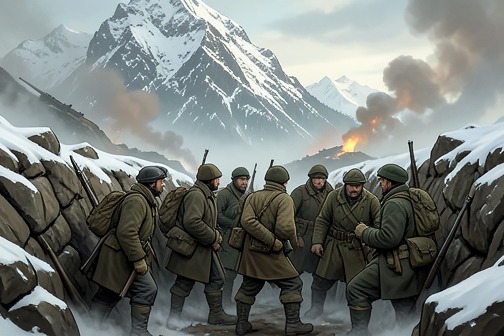
[The capture of Riva Ridge and Mount Belvedere](entity:event-recall-event-0d03b479ec56) is a two-stage mountain operation in [Ben Givens](entity:character-recall-character-ben-givens-0e0f37efeae7)’s wartime recollections: [Riva Ridge](entity:location-recall-location-riva-ridge-64f7931f2a4c) falls first, then the 85th takes [Mount Belvedere](entity:location-recall-location-mount-belvedere-ef6cc84402fa) as Ben’s company prepares to advance. The sequence emphasizes the waiting, bombardment, and movement through the lines as much as the announcements of victory, and distinguishes the units that secured the heights from Ben’s own assignment to the next objective.
## Approach and Position
On a frigid, fog-bound night, Ben’s company left [Vidiciatico](entity:location-recall-location-vidiciatico-f456edd9710a) in refitted quartermaster trucks and hiked from the foot of Mount Belvedere to its line of departure. The men dug slit trenches in rocky ground beneath steep faces dusted with fresh snow. Before the assault, Ben and [Bill Stackhouse](entity:character-recall-character-bill-stackhouse-f01b26bb30f7) had studied an infantry map and learned the names of the surrounding promontories, while German positions remained entrenched along the ridge. The company’s approach was therefore a passage into a prepared front, not an isolated advance across open country.
## The Long Wait Under Fire
After one o’clock, distant gunfire and mortar detonations reached the trenches. At first light, word came down the line that Riva Ridge had been taken, but Ben’s company remained in place through the day as German counter-barrages and artillery continued. The men waited in the February cold; Ben cleaned his BAR and ate from his pack while the firing to the north eventually quieted at dusk.
The bombardment intensified again after dark. Stackhouse used his watch to time rockets fired from Belvedere and identified the heavier rounds as 88s. Ben and the others stayed in their trenches as artillery passed overhead and explosions struck the slopes. The scene’s central rhythm is one of endurance and constrained action: information arrives in brief reports, while the men’s immediate task is to hold their position and wait for orders.
## Mount Belvedere and the Next Objective
At dawn, P-47s bombed the summit of Belvedere. Ben’s company then moved up the slope and took cover behind chestnut trees. At 0700, the company commander reported that the 85th had captured Mount Belvedere and Gorgolesco. General Hays ordered the Third and First Battalions of the 85th to defend those gains against counterattacks. Ben’s own unit, the Third of the 86th, was instead directed through the front lines to take [Monte Della Torraccia](entity:location-recall-location-monte-della-torracci-2a734c967378). The distinction matters: the capture of Belvedere is reported as an achievement of the 85th, while the 86th’s role in this sequence is to continue the advance.
## Cost and Narrative Significance
As the infantry moved toward Mazzancana, the men encountered parties carrying dead soldiers away from the front and wounded men waiting for evacuation. These glimpses place the announcements of captured heights beside the human cost of the operation without making victory seem immediate or uncomplicated. The episode moves from a nighttime departure, through prolonged exposure to fire, to a tactical gain and a fresh order forward. Its ending is not a pause for celebration: Belvedere has been taken, but Ben’s company is already being sent toward another mountain objective.
Event 15
Fighting during the attack on Mount Toraccia and Bill Stackhouse's rescue
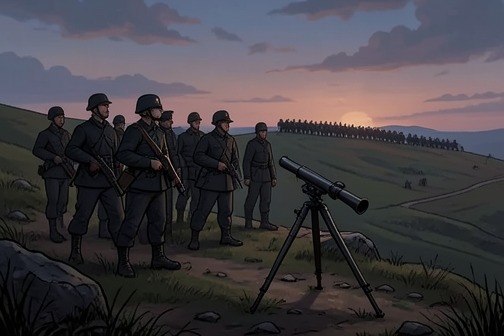
The fighting during the attack on [Monte Della Torraccia](entity:location-recall-location-monte-della-torracci-2a734c967378) is a turning point in [Ben Givens](entity:character-recall-character-ben-givens-0e0f37efeae7)’s wartime experience: amid a collapsing assault and the death of a fellow soldier, he must act under fire to save [Bill Stackhouse](entity:character-recall-character-bill-stackhouse-f01b26bb30f7). The episode moves from a planned advance into confusion and paralysis, then from emergency care to an improvised operation. Decades later, Ben still measures the event against the life Stackhouse went on to live and against his own understanding of the heart.
## The Planned Advance and the Collapse of the Front
Lieutenant Daniels briefs the platoon on a dangerous assignment. At dusk, they are to cross the shoulder of Hill 1018 and take positions on the slopes of Monte Della Torraccia, holding there until daybreak. The front is directly ahead; no friendly troops remain between the platoon and the enemy. Their assault will follow artillery preparation in the morning. The Second of the [85th Regiment](entity:organization-recall-organization-85-63f7036f3cec) has already suffered heavy casualties, leaving Ben’s unit as a second wave aimed at the defended crest. The BAR men are expected to support a frontal attack, while their ammunition bearers must stay close.
The orders make the scale and exposure of the coming fight plain, but they cannot prepare the men for how quickly a unit’s plans dissolve under fire. [Kelly Lastenpole](entity:character-recall-character-kelly-lastenpole-297358186280) sits beside Ben among the pines, his earlier dark humor gone. As the battle unfolds, Lastenpole is killed. Stackhouse is still present, but the group is scattered and disoriented; he asks where everyone has gone and what is happening. The losses are not an abstraction in a tactical plan now. They have a face in the woods beside Ben.
## Ben’s Hesitation and the Decision to Shoot
After Lastenpole’s death, Ben and Stackhouse remain under cover as German soldiers move through the trees. Stackhouse signals them toward their rear rather than attacking them in retaliation. Later, a wounded German approaches their position. When he notices movement in the brush and reaches for his pistol, Stackhouse struggles to ready his rifle and urgently calls on Ben to shoot. Ben cannot act at first. His finger is on the BAR’s trigger, but he feels frozen as the German fires into the undergrowth. Stackhouse is hit; Ben then fires, killing the German.
The sequence makes Ben’s hesitation part of the event’s moral and emotional weight. He has already imagined returning fire for Lastenpole, but Stackhouse had counseled against it. Now the immediate threat is different: Stackhouse is in danger, and the request to shoot is urgent. Ben’s action comes only after the German has fired and Stackhouse has been struck. The shift from paralysis to action does not make the scene a clean victory. It leaves Ben facing another wounded comrade and the need to get him to help.
## Carrying Stackhouse to Medical Care
Ben calls for a medic, but when no help arrives he does more than wait. He carries Stackhouse through the pines toward the rear, with Stackhouse draped across his shoulder, until he finds a soldier wearing a Red Cross brassard. The medic treats Stackhouse in the field, but the seriousness of his condition requires further intervention. Ben’s role changes from a soldier caught between threat and response to a friend physically bearing his wounded companion toward care.
At the operating site, a surgeon prepares to open Stackhouse’s chest while Ben and the medic assist. Ben finds the prospect difficult, yet follows the surgeon’s instructions and helps hold the retractors. The surgeon works while a sergeant ventilates Stackhouse, and the team continues treatment as his condition changes. When Stackhouse’s heart begins beating again, first irregularly and then with a steadier rhythm, the moment is a reversal from apparent death toward the possibility of survival. The surgeon remains focused on keeping him alive and directs the others through the next steps.
Ben offers his own blood when the surgeon asks about his blood type. He confirms that he is O-positive and urges the surgeon to take more. The team draws two pints, which are then started into Stackhouse. Ben sits dazed as the transfusion begins, and Father Carr, the Third Battalion chaplain, later takes him into his care. The rescue is collective: the surgeon, medic, sergeant, and other medical personnel work to sustain Stackhouse, while Ben’s assistance extends from carrying him out of the pines to giving blood.
## Aftermath and the Heart’s Long Memory
After the emergency, Ben remains in the rear for three days, wrapped in blankets on a cot. A division psychiatrist interviews him twice to decide whether he is fit to return to service. He is eventually sent back to the line, but he avoids fighting as the regiment advances across the Po plain and takes part little in the later fighting. The immediate rescue therefore does not end the psychological consequences of the battle. Ben’s response persists in his withdrawal and in his lasting difficulty carrying the war within him.
More than fifty years later, Ben thinks of Stackhouse’s survival and the life that followed. Stackhouse lives with a limp and a shoulder that aches in cold weather, retires from an office-supply sales position in Bethlehem, Pennsylvania, and has eleven grandchildren. He sends Ben photographs and letters over the years; the two men meet three times at reunions of the Tenth Mountain Division and speak at length about what happened. Stackhouse is slowly writing his memoirs so his descendants will know the story too. What began as a desperate effort to keep one man alive has become a shared memory, carried forward in conversation and in the account Stackhouse hopes to leave his family.
That memory also shapes Ben’s way of thinking about the heart. He recalls the operation not as an abstract symbol but as a physical intervention that helped restore Stackhouse’s life. In his later reflections, the heart is first a muscle that pumps blood, while love and other meanings attached to it remain vulnerable to loss. The rescue gives that tension a concrete history: Ben has seen a heart fail and beat again, has supplied some of the blood that sustained his friend, and knows that survival did not erase the battle. Stackhouse’s continued life is the episode’s lasting consequence; Ben’s enduring memory is its cost.
Event 16
Ben and Rachel's marriage in Livorno
[Ben Givens and Rachel Lake](entity:relation-recall-relation-ben-givens-and-rache-b2a8ef2c2a6c) married in Livorno during the final phase of the war in [Italy](entity:location-recall-location-italy-85c2492cd54b), turning a reunion during her brief leave into a lasting bond. The wedding follows their reunion by the Ligurian Sea and leads directly into a journey north on which they imagine their ashes resting together as red and white roses.
## Reunion in Livorno
After Ben sent [Rachel](entity:character-recall-character-rachel-84f0cd683952) a letter in Marseille, she came to Livorno aboard a hospital ship for a leave of twenty days. He searched for her at an encampment of army tents near the city and learned from a nurse that she had gone to swim. When he found her by the sea, both recognized the changes wrought by their wartime separation; Rachel held him and comforted him. The scene makes the wedding a reunion as well as a beginning: their shared history precedes the vows, even as the war has altered the people meeting again.
## The Wedding
The following morning, an army chaplain married them. He set aside ordinary requirements, explaining that he did not require blood tests and would not be deterred by the difference in their military ranks: Rachel was an officer and Ben an enlisted man. He had seen many such weddings as the fighting ended, and treated their wish to marry as part of a wider movement toward love after wartime death. He instructed them to exchange vows of fidelity through good times and bad, had them sign the documents, and sent them on their way.
## Journey North and the Rose Promise
After the ceremony, Ben and Rachel took the chaplain's jeep, bought two bottles of chianti, and traveled toward Florence. They left the jeep there and continued north by train. On the way to Bressanone, Rachel recalled a story in which two lovers' ashes lay side by side: one destined for a red rose, the other for a white, their colors eventually blending into pink. She proposed the image as a way of imagining their own remains together. Ben wondered whether the roses would truly mingle or instead remain red and white, intertwined but distinct. The promise thus held both intimacy and uncertainty: their shared future was imagined, not guaranteed.
## Significance
The marriage takes place amid the aftermath of fighting, but the scene does not present love as an explanation for the war's losses. The chaplain's account links the weddings he performs to the end of combat, while Rachel's rose story gives Ben and Rachel a private image for fidelity beyond their immediate circumstances. Their vows, the signed documents, and the journey north turn a short leave into a commitment whose most enduring expression is the hope that two lives might remain joined even after death.
Event 17
Angel’s medical emergency and hospitalization
[Angel](entity:character-recall-character-angel-b4ecd11d5f8e)’s medical emergency becomes a test of whether [Ben Givens](entity:character-recall-character-ben-givens-0e0f37efeae7) can still act as a physician when he has set out expecting to die. On a [Greyhound](entity:organization-recall-organization-greyhound-56ca3151d772) journey, Ben encounters a young fruit picker whose worsening illness has become an immediate crisis. He recognizes the danger, but care is complicated by the group’s fear of immigration scrutiny and the cost of hospital treatment. The episode turns Ben’s medical judgment into practical action: he calls for help, argues over access and payment, and stays until an ambulance takes Angel and his brother away.
## The crisis on the bus
Angel is traveling with other fruit pickers when his illness intensifies. [Catherine Donnelly](entity:character-recall-character-catherine-donnelly-4b10ffb04631) introduces Ben as a doctor who wants to help. Ben cannot examine Angel properly or offer treatment: he is traveling without medical equipment, not even a stethoscope. From the reported symptoms, he considers tuberculosis and pneumonia, while recognizing that viral, fungal, or bacterial infections could also be responsible. His uncertainty does not make the situation less urgent; he tells the group that Angel needs a clinic or hospital as soon as they reach [Wenatchee](entity:location-recall-location-b0a40ebd989a).
The practical obstacle is not simply the distance to medical care. Catherine warns that hospital staff may ask for identification or immigration papers and that Angel could be expelled from the country. The pickers also have little confidence that help exists outside the system they fear. When Angel suffers a severe coughing fit and brings up blood, the question of whether to seek treatment becomes immediate. His brother tries to comfort him, while Catherine and Ben confront the danger of delay against the risks the group associates with entering a hospital.
## Calling for emergency care
After the passengers leave the bus, Ben decides to call 911 rather than allow the emergency to pass with the journey continuing. At the bus station at First and Chelan, he identifies himself to the operator as a thoracic surgeon and describes Angel’s blood-producing cough as an emergency requiring immediate assistance. He answers the operator’s questions about his identity, credentials, the symptoms, and the journey from Quincy. An ambulance arrives within minutes, and Ben directs the technicians to Angel, explaining his suspicion of tuberculosis and the need for an immediate medical workup.
Catherine serves as an intermediary with the frightened group. Angel’s brother does not want Angel taken away and feels responsible for him; the financial question reinforces his resistance. Ben tells Catherine to reassure them that treatment will not cost them anything, but Coleman, one of the emergency technicians, disputes that assurance. Odle counters that the hospital may be able to seek welfare assistance through the Emergency Medical Office. The disagreement makes plain that a medical emergency is also a dispute over what the system will provide and who can safely rely on it. Ben insists that treatment matters more than the argument over payment, while the technicians begin assessing Angel and prepare to transport him.
## Separation at the station
The ambulance crew takes Angel’s temperature and checks his blood pressure and pulse as the station’s passengers watch. Catherine, who is due to continue west toward [Seattle](entity:location-recall-location-seattle-ec620f372076), asks whether Angel is likely to recover. Ben answers conditionally: he should improve with antibiotics if the suspected diagnosis is right. The answer conveys guarded hope, not certainty; the scene does not establish Angel’s eventual diagnosis or recovery.
Angel’s brother gets into the ambulance with him, but Coleman refuses to take the other young picker. He says there is no legal place for him to ride and that the hospital is within walking distance. The ambulance leaves with Angel and his brother, while the third boy remains in the loading bay with his bags. Catherine has already boarded the westbound bus, which departs without Ben. The emergency thus produces a concrete intervention but does not resolve the wider vulnerability of the traveling group: one sick worker is carried toward care, his companion goes with him, and another picker is left behind.
## Ben’s return to medical action
For Ben, the episode is striking against the purpose of his journey. He had intended to be dead in the sage country, yet he now gives his professional assessment, calls emergency services, and advocates for a stranger. Earlier, while helping a veterinarian treat [Rex](entity:character-recall-character-rex-63f19e2954a3), he had felt the unexpected pull of assisting with surgery after nineteen months away from operating on a human heart. The Angel episode extends that contrast: Ben has no equipment and cannot provide treatment himself, but he can recognize danger, communicate it clearly, and persist in getting help to someone whose circumstances make asking for it difficult.
His conduct does not remove the institutional barriers. He initially promises that care will cost nothing, only to have that assurance challenged; the technicians disagree about available assistance, and the concern about papers remains part of the decision. What Ben can do is refuse to let those uncertainties eclipse the immediate medical risk. The event therefore marks neither a cure nor a resolution, but a change in the direction of his attention: in the midst of a plan to end his own life, he assumes responsibility for another person’s chance to receive care.
Event 18
Ben and Emilio's journey to the Wolfhound orchard
Ben and [Emilio](entity:character-recall-character-emilio-e4dff4d01b98)’s journey to [Wolfhound Orchard](entity:location-recall-location-wolfhound-orchard-bf71e139e4af) transforms a chance encounter into a chain of practical obligations: an injured, grieving doctor helps a young migrant find work, and the work site soon calls on that same doctor to assist a woman in labor. The route is marked not by a single revelation but by repeated acts of care, undertaken while Ben himself struggles to keep moving.
## From Orchard Country to the Bus Station
Ben’s help for Emilio grows from a landscape and a kind of labor he already knows. As a boy, Ben worked in his parents’ orchards alongside [Aidan Givens](entity:character-recall-character-aidan-givens-82b9c7406e11): making apple boxes, cleaning irrigation ditches, tending young trees, and thinning and supporting fruit-heavy branches. The seasonal cycle culminated in the August harvest. Migrant pickers arrived from across the country after following work north through successive crops; they brought families, bedrolls, and stories of a life shaped by travel and short-term labor. That childhood gives Ben a practical understanding of the work Emilio is seeking, rather than merely a general impulse to help.
At the [Wenatchee](entity:location-recall-location-b0a40ebd989a) bus station, Ben has already acted on his medical training. When [Angel](entity:character-recall-character-angel-b4ecd11d5f8e) collapses coughing blood, Ben calls emergency services, identifies himself as a doctor, gives the operator the station’s location at First and Chelan, and explains that Angel needs immediate assistance. He directs the arriving technicians to the sick young man and communicates his concern about the symptoms. After the ambulance leaves with Angel and his brother, another boy remains behind with plastic bags. Ben’s own condition is poor: he is limping, burdened by his rucksack, and suffering from the effects of a recent car wreck. Yet he does not simply leave the stranger to manage alone.
The boy cannot speak English, and Ben cannot readily communicate in Spanish. Emilio conveys that he wants work picking apples, using gestures and a few words. Ben buys a Spanish travel guide and an English-Spanish dictionary, then studies them with Emilio on a sidewalk, trying to establish that apple harvesting is the job he means. Their exchange is halting, but it gives the encounter a direction: Ben can connect a request for work to a place and an employer.
## A Meal, a Name, and a Job
Before making calls, Ben recognizes that Emilio is hungry and takes him to a restaurant on Wenatchee Avenue. He orders himself tea and Emilio a T-bone steak with fried potatoes. Emilio eats carefully and with evident dignity, while Ben struggles with the language books. He learns that Emilio is not the brother of the two boys who had been traveling with him; they had met while picking pears near Yakima and then gone on. Emilio has continued alone because he still wants work. He gives Ben only his first name. His employment card, however, bears the name Raul Ramirez, a detail that sits beside the limited story Emilio chooses to tell.
Ben does not press him for an account of how he became separated from others or what life he left behind. The silence is not a failure of the journey’s purpose: the immediate need is food and a chance to work, not a complete explanation of Emilio’s past. After the meal, Ben buys him apple pie and milk, then calls the Job Services Office. A job specialist explains that the harvest is nearly over and the available agricultural work will last only days. Ben keeps asking where Emilio can go and secures a referral to Wolfhound Orchard, where positions are available.
Back at the table, Ben explains the opportunity as best he can and opens a map of Chelan County. He traces the route to Malaga, down the west side of the Columbia on the Malaga-Alcoa Highway, repeating that there are apples to pick. Emilio understands. Their roles begin to shift: Ben has found the destination, but as they continue through town Emilio will carry both their bags when Ben’s pain forces him to stop. The assistance is no longer moving in only one direction.
## The Road to Wolfhound Orchard
Ben rents a half-ton Ford despite his visible injuries and the clerk’s suspicion of the two travelers. The drive takes them through the [Stemilt Hills](entity:location-recall-location-stemilt-hills-eca9542dc6fd), climbing a thousand feet above the river along switchbacks and tight turns. Orchards cover hillsides that had once held grapes, English walnuts, and pears. They pass fruit pickers’ camps, trailers, cabins, and a silent cherry-packing shed; farther on, workers stand on ladders in the apple rows. Ben points out the crop to Emilio, making the promised work visible in the landscape itself.
The journey costs Ben physically. At the community church he stops with the engine running because his side hurts too much for him to continue. Later, as evening deepens, he parks near Joe Miller Road and walks with one arm held across his abdomen. At Wolfhound Orchard, contractor Lyle Parmenter checks Emilio’s employment card and Ben’s identification. He notices Ben’s surname and asks whether he is related to the Givens family across the river. Ben denies the connection. Parmenter also doubts that an older man can handle picking, calling it young men’s work. Ben answers that age has taught him how to do the job correctly. The exchange makes the orchard a place where Ben’s own past labor is tested against his present, injured body.
The camp is part of the working conditions Emilio has entered, not just a destination on Ben’s map. Sanchez leads them along a dirt track past dark orchards, fire-damaged pear branches, a row of weathered cabins, a washhouse, and a large equipment shed. Beyond the pines, pickers’ trailers form a rough arc in a dusty field. The camp has a washhouse with hot water, showers, a heater, and a washing machine; it also has the close, shared atmosphere of a seasonal workplace. Ben collapses onto a bench, but dismisses Sanchez’s concern as indigestion. Emilio, by contrast, has reached the place where he can seek the employment he traveled for.
## The Doctor’s Work Continues
That night, Emilio wakes Ben and urgently asks for a doctor. Sanchez explains that a woman in the camp is having a baby and that the child is stuck. Ben agrees to go with them. They cross the orchard beneath the stars, pass trailers where workers have gathered, and reach the woman’s trailer. The journey’s destination has become more than a source of wages: the doctor who brought a worker to the camp is now needed by the people living there.
Ben assesses the situation and sees that the baby’s head is showing. He tells the family that it is too late to reach a hospital and asks how hot the water is. The moment brings his medical identity into the foreground again, after he has already used it for Angel and accepted responsibility for [Rex](entity:character-recall-character-rex-63f19e2954a3)’s treatment earlier in his journey. In each case, care takes concrete form despite cost, fatigue, or pain: he calls for emergency help, stays to assist with Rex’s treatment, and now responds to the camp’s urgent request.
The journey therefore resists a simple division between helper and helped. Ben brings Emilio to work, but Emilio waits patiently when Ben must stop, carries their bags, and wakes him when someone needs a doctor. The orchard is both a return to a world Ben once knew through family labor and a new setting for service among migrant workers. His route ends not in withdrawal from other lives but in renewed involvement with them.
Event 19
Doris Perez's difficult labor and the baby's birth
Doris's difficult labor and the birth of her daughter become a test of Ben's medical identity at the [Wolfhound Orchard](entity:location-recall-location-wolfhound-orchard-bf71e139e4af): decades after his obstetrics training, and far from a hospital, he must turn incomplete knowledge into urgent practical care. The episode moves from uncertainty about whether he can help to a successful delivery, while preserving the limits of what he can do for Doris and the newborn afterward.
## The Call for Help
Ben is awakened by [Emilio](entity:character-recall-character-emilio-e4dff4d01b98), who repeatedly calls him señor and asks urgently for a doctor. Sanchez, the field boss, explains that a woman in the camp is having a baby and asks whether Ben can do anything. Ben agrees to go with him. The request arrives in an improvised setting: the people around Doris have no professional attendant available, and her labor is already underway.
In the trailer, Ben finds Doris laboring while several people try to help. [Jimmy Perez](entity:character-recall-character-jimmy-perez-ef412da3a435) is beside her; another woman speaks urgently in Spanish, and a short woman prepares hot water at a propane stove. Their presence makes the scene a shared effort, but no one else claims the medical knowledge needed to manage the birth. Ben's first response is not to pretend certainty: he asks whether the woman at the stove is a midwife, and she says she knows nothing.
## Experience and Its Limits
Ben pauses with a hand to his forehead as he confronts how long it has been since he last attended a birth. He had assisted with deliveries for six weeks during his obstetrics internship in 1954, forty-four years earlier. He calls for an ambulance and says Doris needs a hospital. This is both a recognition of his limitations and an attempt to get her the care he cannot provide in the trailer.
That caution belongs to a broader pattern in the episode's surrounding medical encounters. Ben has recently assisted Dr. Peterson with surgery on [Rex](entity:character-recall-character-rex-63f19e2954a3), despite having spent his career repairing human hearts rather than treating dogs. Earlier, asked to assess a sick orchard worker, he calls the illness a mystery and lists tuberculosis or pneumonia as possibilities among many infections; he stresses that he cannot diagnose or treat the man without even a stethoscope, and advises a hospital visit. In each case, Ben distinguishes a willingness to help from the claim to possess resources or certainty he lacks.
With Doris, the situation changes when Ben sees that the baby's head is showing. He tells Jimmy that it is too late to go to the hospital. The decision is no longer whether to deliver Doris in the trailer, but how to do so as safely as he can with the people and supplies present. His old training cannot restore the missing hospital, ambulance, or equipment. It can, however, guide his attention to what is happening and what must be done next.
## The Delivery
As the birth becomes imminent, Ben watches the progress and tells those around him that the baby is coming. The delivery does not proceed easily: the child is stuck at the shoulders and is not breathing. Ben searches for a way to free the baby, using his hands to find the position of the arm and gradually release the shoulder. His actions are difficult for Doris, but he continues because the baby must be delivered. The scene presents medical care as immediate responsibility under pressure, not as mastery or ease.
The baby finally emerges, a girl. Ben catches her and works to stimulate her breathing: he clears her mouth, blows on her face, turns her, flicks her feet, and pats her back. She begins to move and make small cries, and her color improves. Jimmy crosses himself; the people present respond with relief and wonder. Ben remains trembling, a bodily sign that the outcome has not been emotionally or physically effortless even though the delivery has succeeded.
He then swabs the baby and places her, covered, on Doris's belly. When a sharp knife and twine are requested, Sanchez supplies a folding blade and Ben sterilizes it with rubbing alcohol. He ties the umbilical cord in two places before cutting between them. He checks that the placenta has been delivered and examines the baby again; she is nursing vigorously. These practical steps extend the scene beyond the dramatic moment of birth into the work of making sure mother and child are cared for afterward.
## Aftercare and Significance
Ben checks Doris's lower abdomen and finds that her uterus has contracted; he sees no immediate danger from bleeding. He does not treat that assessment as a substitute for professional follow-up. He tells Jimmy to take both Doris and the baby to a doctor as soon as Doris has rested, pointing them toward a clinic in [Wenatchee](entity:location-recall-location-b0a40ebd989a) and noting that Doris needs stitches. His advice acknowledges what the successful delivery cannot resolve: the need for continued medical care in a community where access to it is not immediate.
When Sanchez later reports that mother and baby are sleeping, Ben asks what they named the child. Sanchez answers, Ellen Dolores. Ben again asks him to remind the family that both mother and baby should see a doctor. The name and the report of rest give the episode a quiet aftermath, but not a claim that all risks have passed; Ben's final concern remains follow-up care.
The episode's decisive change is from a request Ben might have refused on grounds of distance and age to an emergency he must meet because transfer is no longer possible. His medical past returns not as unquestioned authority but as a limited resource: he has not attended a birth in decades, lacks the setting and equipment of a hospital, and still has to act. The birth also contrasts with his earlier intention to die in the sage country. At a moment when he had expected his own story to end, he is called into another family's crisis and helps bring a child into the world. The episode does not erase his own suffering; it places that suffering beside a concrete act of care and an obligation that continues after the immediate emergency.
Event 20
Ben gives the Winchester rifle back to William Harden
[Ben Givens](entity:character-recall-character-ben-givens-0e0f37efeae7)’s decision to relinquish his family shotgun to [William C. Harden](entity:character-recall-character-william-c-harden-057029a69c71) resolves their dispute by changing its meaning: Ben arrives prepared to recover a valued inheritance, then chooses to give up his claim and the history of killing he associates with it. The confrontation turns a quarrel over a stolen weapon into a renunciation of the gun itself.
## The dispute behind the visit
The conflict began after Harden’s hounds attacked Ben’s [Brittany dogs](entity:creature-recall-creature-brittany-dogs-9fb015f86198). Ben had killed one of the attacking hounds, and Harden had taken Ben’s gun. When [Bea Harden](entity:character-recall-character-bea-harden-759bc54bc18f) learned what had happened, she expressed regret that Harden had no other hobby and said she intended to speak with him. Her response recognizes the continuing conflict between the men without claiming to settle it on Ben’s behalf.
Ben, however, tells her not to raise the matter. Although she reminds him that the gun belongs to him, he says he does not want it back. The exchange establishes that the later visit is not simply an effort to reverse Harden’s action. Ben has already begun to refuse the object, even while its family ownership remains clear.
## Ben confronts Harden
Ben later sees William C. Harden at a maintenance shed and calls to him by name. He identifies himself as the hunter whose Winchester Harden took. Harden disputes Ben’s description of the taking and tells him to leave. Ben nevertheless approaches and says that he came to get the gun back but has changed his mind. His stated purpose therefore shifts in the course of the encounter: he has come to reclaim it, but no longer intends to do so.
Harden keeps hold of a power drill while Ben speaks, and sets down the other supplies he is carrying. The scene remains a confrontation, but Ben does not try to take the weapon by force. Instead, he explains what the gun represents to him. It had been in his family for sixty years; his father used it to hunt birds, and Ben later killed birds with it as well. The inheritance links their actions across generations, making the gun not merely a possession disputed by two men but an instrument through which the same practice has continued.
## Renouncing the weapon
Ben’s account does not idealize the family history attached to the gun. He acknowledges both his father’s hunting and his own, then judges the object and its legacy as bad. He calls the gun cursed and extends that judgment to all guns. The progression matters: his rejection is not based only on Harden’s taking of this particular weapon, since Ben’s judgment reaches beyond the immediate dispute to firearms more generally.
Ben moves closer, removes his glasses, and tells Harden to take the gun. He says he is passing it on and washing his hands of it. Because Harden already has possession of the weapon, the act is best understood as Ben’s surrender of any claim to recover it, rather than a scene in which he physically hands over a gun he is holding. The transfer is completed as a declaration of relinquishment: Ben leaves the object with the man who took it and refuses to resume ownership.
## Consequences and significance
The encounter reverses the expectation created by Ben’s arrival. He comes to recover an object that has belonged to his family for decades, but the history he recounts becomes the reason to let it go. The shotgun’s family value and its capacity for harm remain joined in his speech; inheritance does not make it innocent, and possession does not obligate him to keep it. His words make the decision explicit, while his refusal to use force gives that decision practical form.
The episode also concludes the immediate dispute without suggesting that Ben and Harden have reconciled. Bea had proposed talking to Harden, but Ben handles the encounter himself and asks to be understood not as a man seeking another contest over the gun but as someone who no longer wants it. The weapon stays with Harden, and Ben’s family connection to it ends by choice. In the surrounding sequence, the story turns away from the confrontation as Bea drives Ben upriver through the orchards of his childhood. That movement places his renunciation beside a return to an older landscape, but the event’s decisive change is narrower and concrete: Ben gives up the claim to his family’s Winchester and the violent inheritance he sees embodied in it.